
Grammar: Gerund (Verb followed by ING) or Infinitive Pronunciation: Long vowel /uː/ -BOOT. Short vowel /ʊ/ BOOK
LISTENING PRACTICE
Use the audio player at the bottom of the screen to listen. Use the player’s control to slow it down if necessary.
TEXT
Rapa Nui
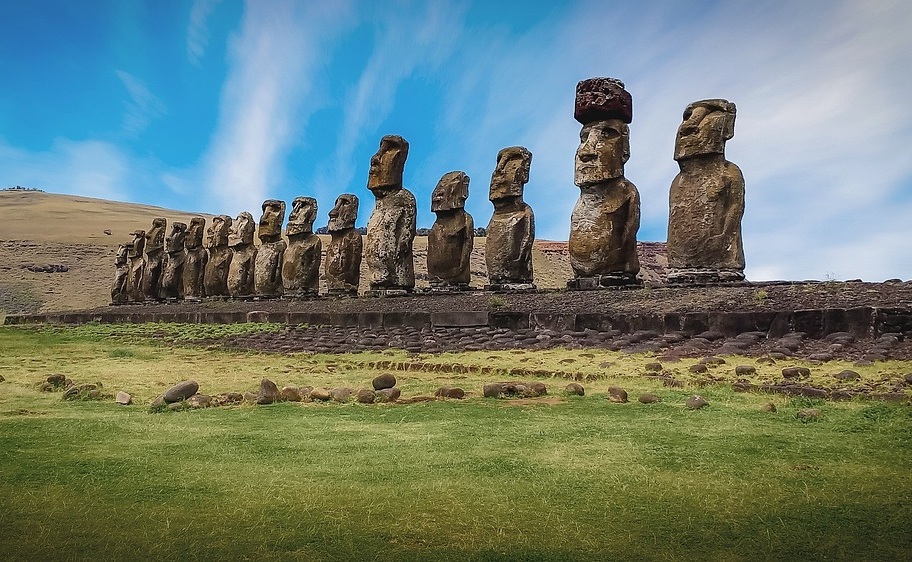
Far out in the Pacific Ocean, over 3,500 kilometers off the coast of Chile, lies a tiny island called Easter Island. Known as Rapa Nui by its native people, this remote island is famous for its mysterious giant stone statues called moai.
The first people to live on Easter Island came from Polynesia, a group of islands spread across the Pacific. Around 1200 years ago, brave explorers sailed in wooden canoes across vast oceans, guided only by the stars and waves. They settled on Easter Island and built a unique culture, full of stories, traditions, and incredible stonework.
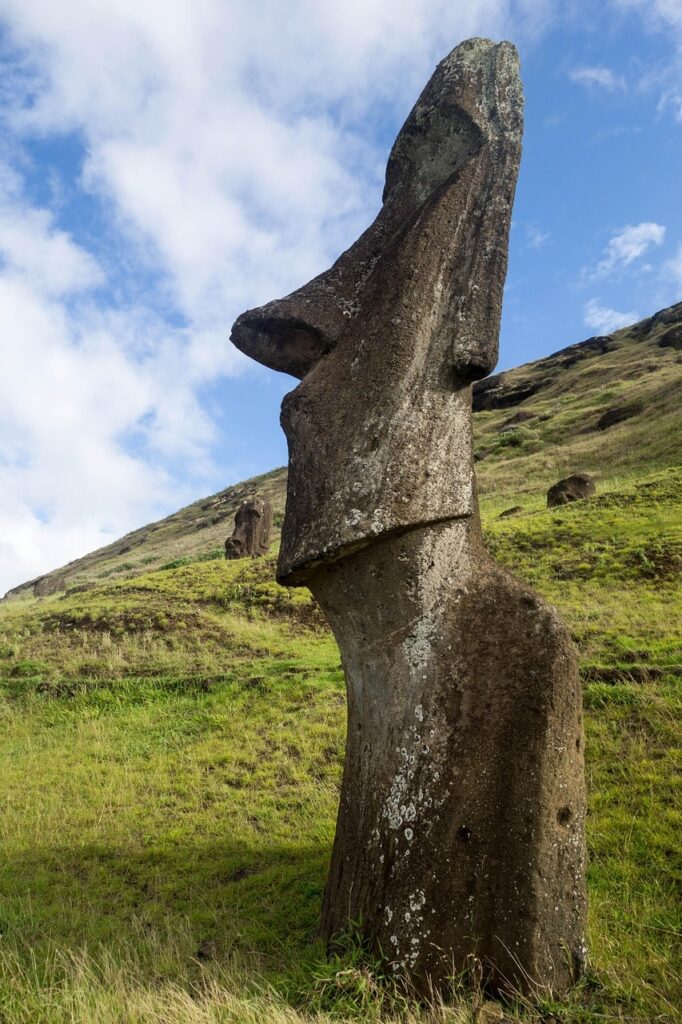
The most famous part of Easter Island is the moai—huge stone heads carved from volcanic rock. Some are as tall as a two-story building and weigh more than 80 tons! But here’s the mystery: no one knows exactly why they were built or how they were moved across the island. There are nearly 900 moai scattered around, many placed on stone platforms called ahu. Some experts believe the statues were made to honor important ancestors or chiefs, while others think they were part of religious ceremonies. What’s even more puzzling is that the islanders didn’t have wheels or big animals to help move the statues. So how did they do it? That’s still a mystery!
The landscape of Easter Island is just as fascinating. It’s made up of three extinct volcanoes, giving the island its triangle shape. The land is covered in grassy hills, rocky cliffs, and beautiful beaches. There aren’t many trees today, but long ago, the island was full of forests. Over time, the trees disappeared—possibly because they were used to help move the moai or build homes and canoes.
So next time you see a picture of a giant stone head with a long face and deep eyes, remember: it might be one of the moai from Easter Island, standing tall and silent, guarding the mysteries of the past.
NEW WORDS
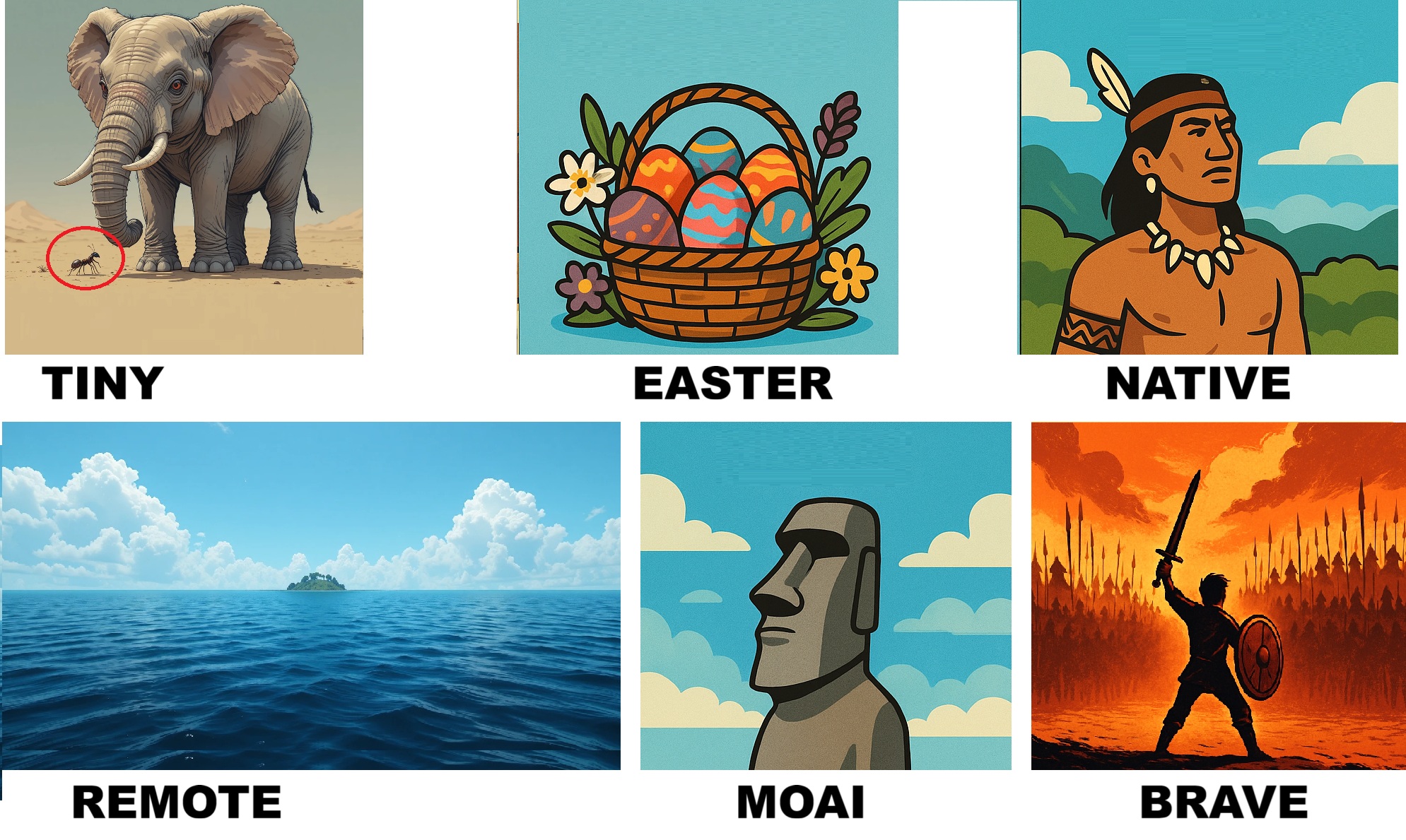
Tiny – Very, very small.
Easter – A holiday in spring that celebrates new life; many people hunt for eggs and eat chocolate.
Native – A person who lived in a country people new people arrived.
Remote – Very far away from where most people live.
Moai – Big stone statues with long faces, made long ago on Easter Island.
Brave – Not scared to do something hard or dangerous.
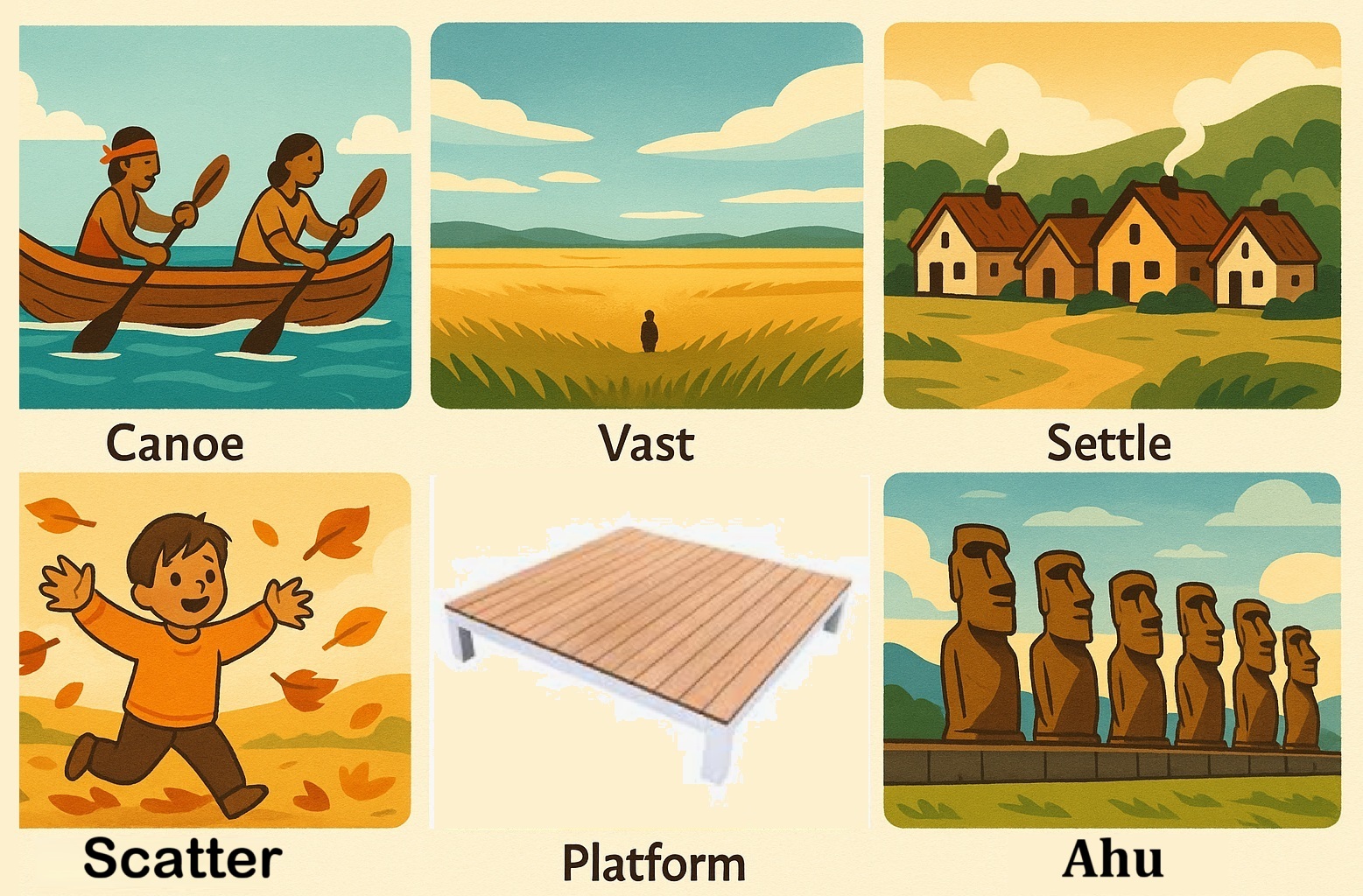
Canoe – A small boat you paddle, often used on lakes or rivers.
Vast – Really big and wide, like the ocean or sky.
Settle – To move to a place and live there.
Scatter – To throw or spread things around in different directions.
Platform – A flat surface you can stand on, like a stage or a raised area.
Ahu – A stone base or platform where Moai statues stand on Easter Island.
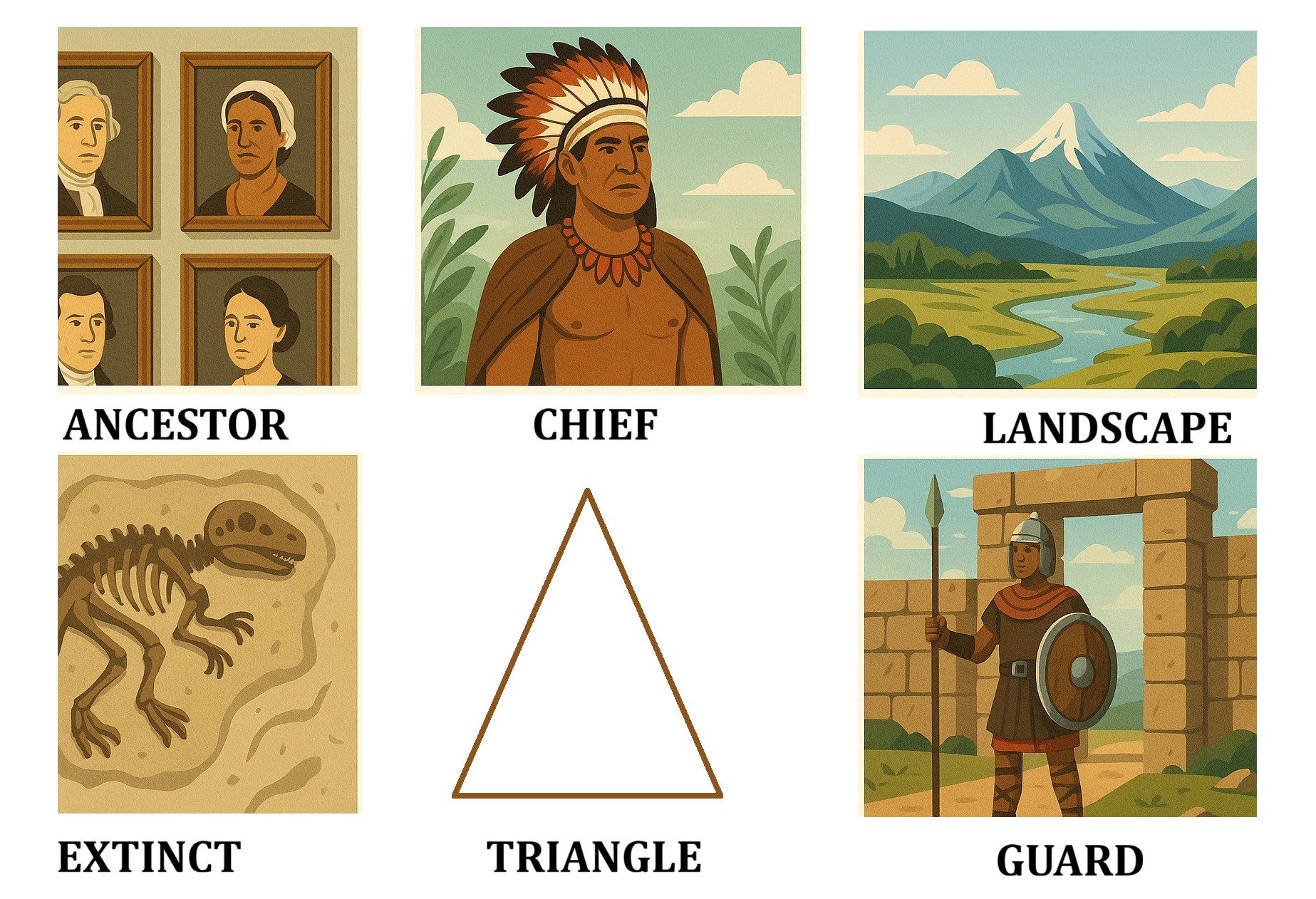
Ancestor – A family member from long ago, like a great-great-grandparent.
Chief – A leader of a group or tribe.
Landscape – What you see when you look at nature outside—like hills, trees, and rivers.
Extinct – When something, like an animal or plant, no longer exists anywhere.
Triangle – A shape with three sides and three corners.
Guard – Someone who watches and protects people or places.
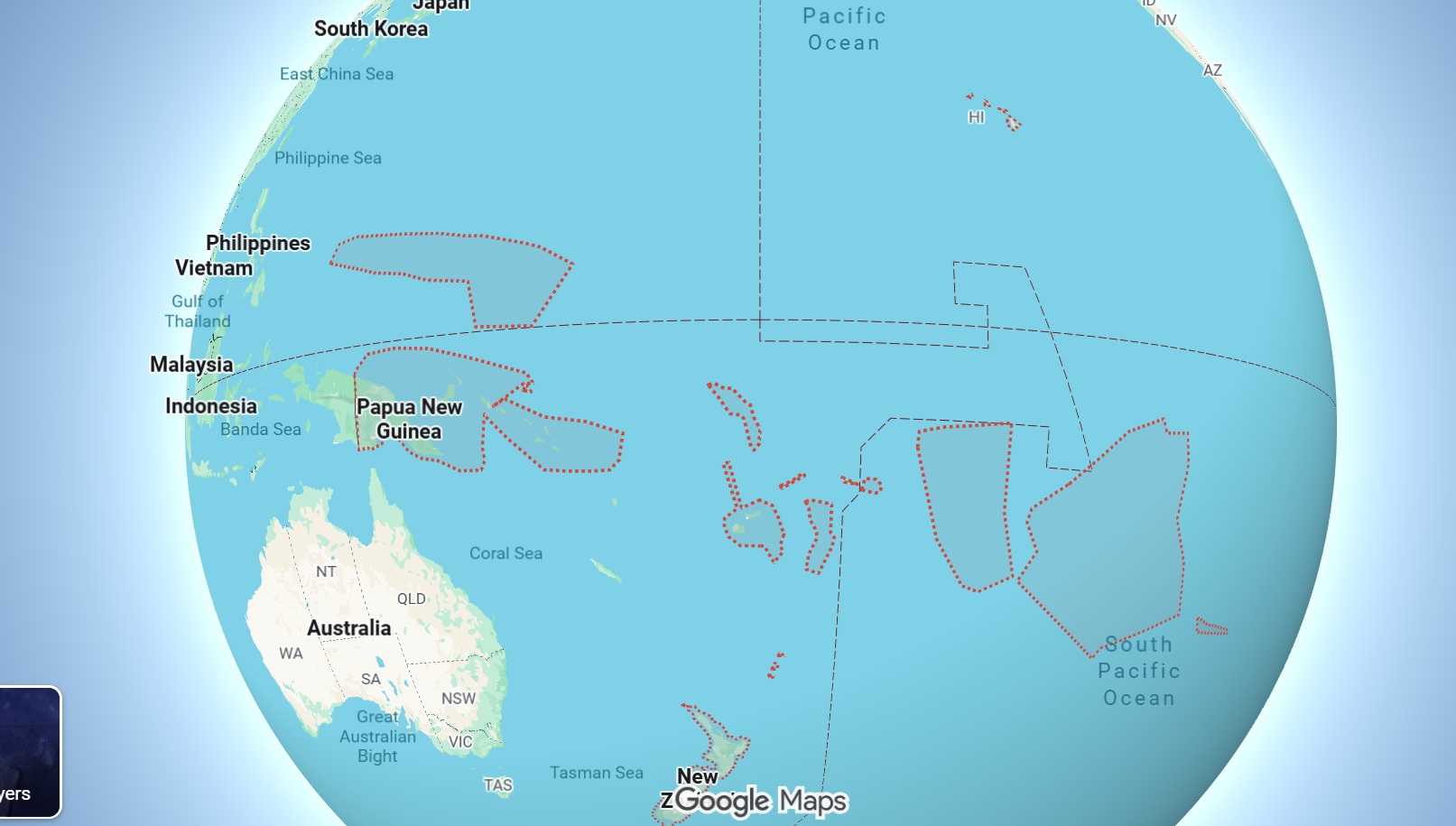
Polynesia – A group of islands in the Pacific Ocean, like Hawaii and Easter Island.
Tradition – Something people do again and again because it’s special to their family or culture.
Incredible – So amazing it’s hard to believe!
Puzzling – Hard to understand or figure out; like a mystery.
Fascinating – Super interesting and fun to learn about.
Expert – Someone who knows a lot about one thing and is really good at it.
TEST YOUR VOCABLARY – Say the word that goes with the image
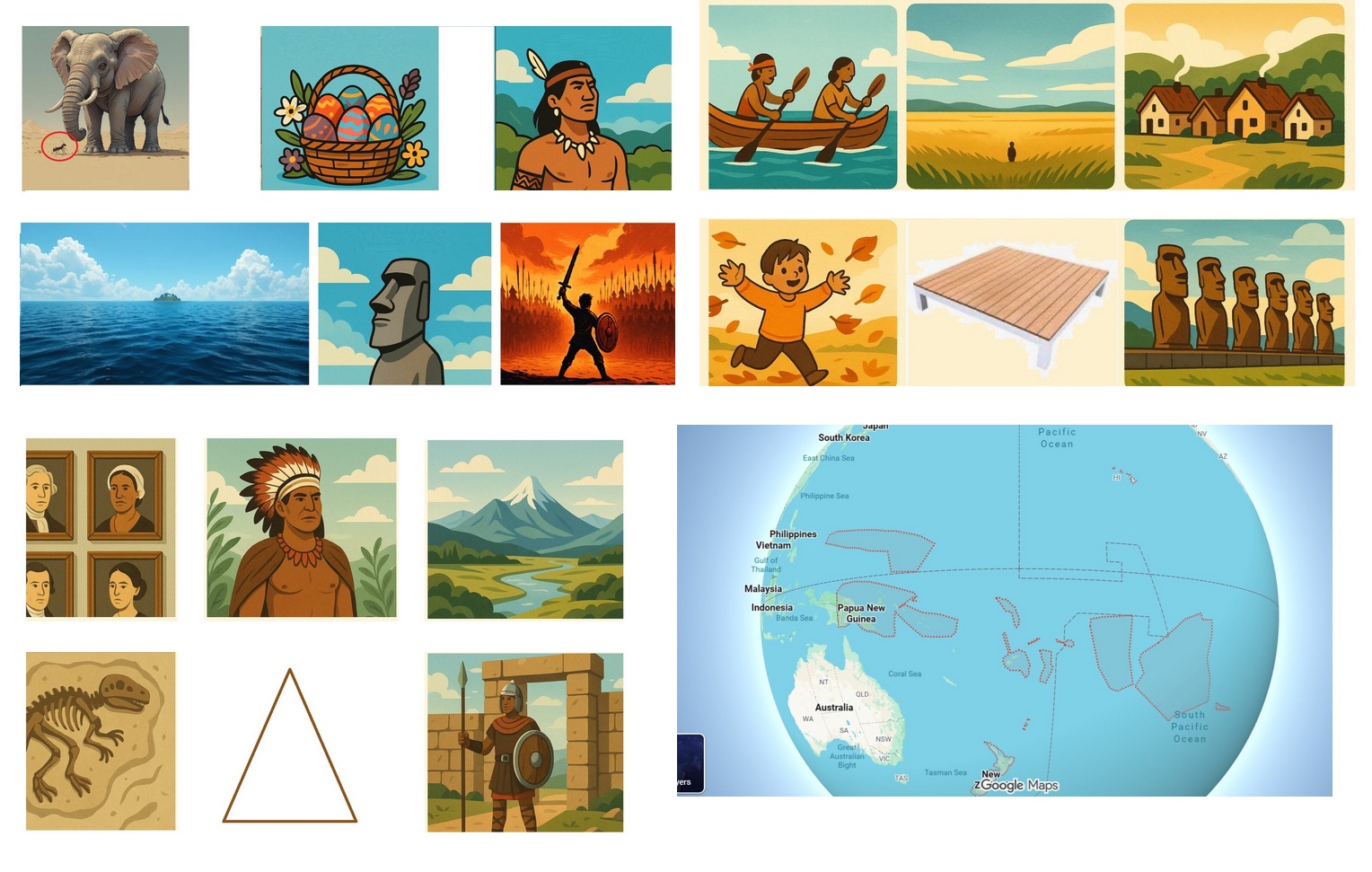
TEST YOUR VOCABLARY – Fill in the blanks
FILL IN THE BLANKS
Rapa Nui
Far out in the Pacific Ocean, over 3,500 kilometers off the coast of Chile, lies a tiny [very small] island called Easter Island. Known as Rapa Nui by its native [original people] people, this remote [very faraway ] island is famous for its mysterious giant stone statues called moai.
The first people to live on Easter Island came from Polynesia [Many Islands], a group of islands spread across the Pacific. Around 1200 years ago, brave [courageous] explorers sailed in wooden canoes [type of boat] across vast [very big] oceans, guided only by the stars and waves. They settled [came to live] on Easter Island and built a unique culture, full of stories, traditions [way of living], and incredible [hard to believe] stonework.
The most famous part of Easter Island is the moai—huge stone heads carved from volcanic rock. Some are as tall as a two-story building and weigh more than 80 tons! But here’s the mystery: no one knows exactly why they were built or how they were moved across the island. There are nearly 900 moai scattered [spread wide] around, many placed on stone platforms [flat structure] called ahu. Some experts [people with deep knowledge] believe the statues were made to honor important ancestors [people who started your branch of family] or chiefs [leader of a tribe], while others think they were part of religious ceremonies. What’s even more puzzling [difficult to understand] is that the islanders didn’t have wheels or big animals to help move the statues. So how did they do it? That’s still a mystery!
The landscape of Easter Island is just as fascinating. It’s made up of three extinct volcanoes, giving the island its triangle shape. The land is covered in grassy hills, rocky cliffs, and beautiful beaches. There aren’t many trees today, but long ago, the island was full of forests. Over time, the trees disappeared—possibly because they were used to help move the moai or build homes and canoes.
So next time you see a picture of a giant stone head with a long face and deep eyes, remember: it might be one of the moai from Easter Island, standing tall and silent, guarding [protecting] the mysteries of the past.
WORDS
Tiny. Canoe. Expert. Brave. Remote. Scatter. Fascinating. Platform. Chief. Tradition. Vast. Easter. Guard. Extinct. Incredible. Native. Triangle. Ahu. Settle. Landscape. Puzzling. Ancestor. Polynesia. Moai.
TEST YOUR LISTENING SKILLS – ANSWER THE QUESTIONS BELOW
Use desktop mode on mobile devices
1. What is the native name for Easter Island?
a) Moai
b) Rapa Nui
c) Ahu
d) Polynesia
2. Where did the first settlers of Easter Island come from?
a) Africa
b) South America
c) Polynesia
d) Europe
3. What is a “moai” ?
a) A wooden canoe.
b) A Rapa Nui tribe.
c) A Polynesian dress.
d) A giant stone statue.
4. Why is the construction and movement of the moai considered mysterious?
a) They were built underwater
b) They were made of unknown materials
c) Islanders had no wheels or large animals to move such large objects.
d) They were built using modern machinery
5. What geographical feature gives Easter Island its triangle shape?
a) Three extinct volcanoes
b) Three rivers
c) Three valleys
d) Three mountains
6. How long ago did the first settlers arrive on Easter Island?
a) About 500 years ago
b) Around 1200 years ago
c) Nearly 2000 years ago
d) Just a few centuries ago
7. What guided the explorers during their trip to Easter Island?
a) Maps and compasses
b) The sun and moon
c) Stars and waves
d) Bird flights.
8. What is an ahu?
a) A type of canoe
b) A volcanic crater
c) A stone platform
d) A ceremonial dance
9. What material was used to build the moai statues?
a) Coral
b) Volcanic rock
c) Cement.
d) Granite
10. What natural change affected the island’s forests over time?
a) Climate cooling
b) Earthquakes
c) Tree disease
d) Human use of trees for building and transport
Answers: 1-b, 2-c, 3-d, 4-c, 5-a, 6-b, 7-c, 8-c, 9-b, 10-d
GRAMMAR
Some English verbs are followed only by gerunds (verb + -ing), others only by infinitives (to + verb), and some can take either—with or without a change in meaning.
Here’s a structured guide to help you teach or learn them effectively:
Verbs Followed by Gerunds Only
These verbs are typically followed by a gerund when another action follows:
- Common examples:
- Enjoy: I enjoy reading.
- Avoid: She avoids driving at night.
- Consider: We considered moving to Canada.
- Finish: He finished writing the report.
- Suggest: They suggested meeting earlier.
- Keep: Keep practicing every day.
- Miss: I miss seeing my friends.
- Discuss, recommend, delay, deny, risk, mind, give up, practice, postpone
Verbs Followed by Infinitives Only
These verbs are followed by the infinitive form when another action follows:
- Common examples:
Verbs That Take Both (No Change in Meaning)
These verbs can be followed by either a gerund or an infinitive with little or no change in meaning:
| Verb | Gerund Example | Infinitive Example |
|---|---|---|
| Begin | He began working. | He began to work. |
| Continue | She continued reading. | She continued to read. |
| Like | I like swimming. | I like to swim. |
| Love | We love dancing. | We love to dance. |
| Hate | They hate waiting. | They hate to wait. |
| Start | I started cooking. | I started to cook. |
Verbs That Take Both (Change in Meaning)
These verbs change meaning depending on whether they’re followed by a gerund or infinitive:
| Verb | Gerund Meaning | Infinitive Meaning |
|---|---|---|
| Stop | Stop an action (stop smoking) | Stop to do something (stop to smoke) |
| Remember | Recall a past action (remember meeting) | Do something you must not forget (remember to meet) |
| Try | Experiment (try eating less) | Make an effort (try to eat less) |
| Regret | Feel sorry about a past action (regret saying) | Feel sorry about what you’re about to do (regret to say) |
| Forget | Forget a memory (forget meeting) | Forget to do something (forget to meet) |
| Go on | Continue an action (go on learning) | Proceed to a new action (go on to learn) |
GRAMMAR TEST
Hover over the blank space (tap & hold then hit the “back” navigation arrow on phones) to reveal the answer
MAKE A SENTENCE
- Refuse – A boy is offered candy by a friend. He shakes his head and says, “No thanks.” Later, he tells someone:
“I refused to eat the candy.” - Practise – A group of students joins a speaking club. They meet every morning before class. Later, one tells someone:
“We practised speaking every day.” - Offer – A girl sees her friend carrying heavy books. She walks over and offers help. Later, she tells someone:
“I offered to help with the books.” - Consider – A family talks about moving to a new town. They look at houses and schools. Later, one parent tells someone:
“We are considering moving.” - Miss – A student moves to a new school. She thinks about her old friends. Later, she tells someone:
“I miss talking with them.” - Choose – A boy has two games to play. He picks one and starts playing. Later, he tells someone:
“I chose to play this one.” - Can’t help – A girl hears a funny joke. She laughs loudly and can’t stop. Later, she tells someone:
“I can’t help laughing.” - Enjoy – A girl reads every night before sleep. Her friend asks why. Later, she tells someone:
“I enjoy reading before bed.” - Decide – Two friends talk about going to the park. They want to go early. Later, one tells someone:
“We decided to go early.” - Give up – A boy tries to fix his toy but it won’t work. He sighs. Later, he tells someone:
“I gave up trying.” - Hope – A student studies hard for a test. She wants to do well. Later, she tells someone:
“I hope to do well.” - Ask – A boy wants to see the nurse. He goes to the teacher. Later, he tells someone:
“I asked to go.” - Feel like – A girl hears music and starts dancing. Her friend asks why. Later, she tells someone:
“I feel like dancing.” - Prepare – A student stands in front of the class with notes. Later, she tells someone:
“I prepared to speak.” - Suggest – A group of friends is bored. One has an idea. Later, that friend tells someone:
“I suggest going to the park.” - Afford – A boy sees a toy he likes but it’s expensive. Later, he tells someone:
“I can’t afford to buy it.” - Avoid – A girl doesn’t eat sweets. Her friend asks why. Later, she tells someone:
“I avoid eating sugar.” - Expect – A student finishes work early. He feels ready. Later, he tells someone:
“I expect to be done soon.” - Admit – A boy takes the last cookie. Later, he tells someone: “I admit taking it.”
- Plan – A family talks about next summer. They want to go somewhere. Later, one child tells someone:
“We plan to travel.” - Mind – A girl asks her friend to close the door. Later, she tells someone: “Do you mind closing it?”
- Learn – A student joins a music class. She wants to play. Later, she tells someone:
“She is learning to play.” - Want – A boy sees a dog and smiles. Later, he tells someone:
“I want to have a dog.” - Promise – A girl tells her mom she’ll clean her room. Later, she tells someone:
“I promise to do it.” - Agree – Two students talk about working together. Later, one tells someone:
“We agreed to share the work.” - Would like – A boy sees a picture of a beach. Later, he tells someone:
“I would like to go there.” - Love – A girl plays the piano every day. Later, she tells someone:
“I love playing music.” - Like – A boy swims in the lake every summer. Later, he tells someone: “I like swimming there.”
- Dislike – A student doesn’t enjoy running. Later, she tells someone:
“I dislike running in the morning.” - (Optional replacement for “Ancestor”) – A student remembers her grandfather who built houses long ago. Later, she tells someone:
“My grandfather used to build houses.”
PRONUNCIATION TIPS
How to pronounce the /u/ (as in boot) and / ʊ / (as in book) sounds.
Long vowel /uː/ -BOOT
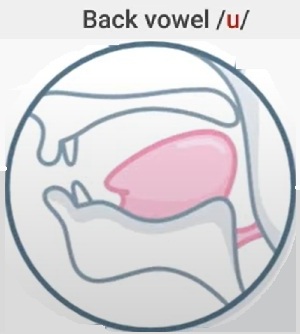
Short vowel /ʊ/ BOOK
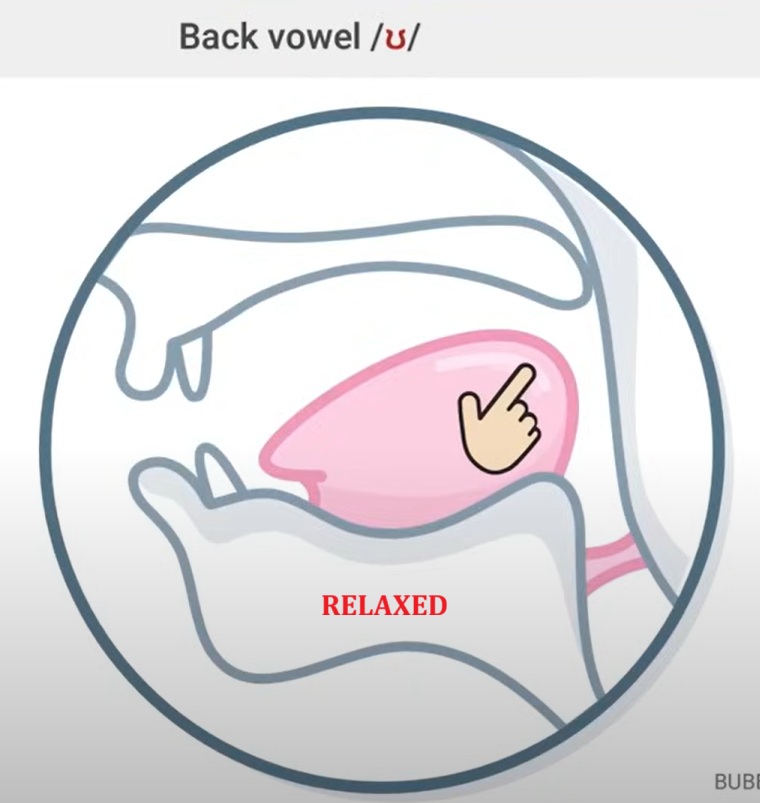
Key Differences
Length:
– boot has a long vowel /uː/
– book has a short vowel /ʊ/
Tongue Position:
– In boot, the tongue is higher and further back (tense).
– In book, the tongue is slightly lower and more central (relaxed).
Lip Rounding:
– Both are rounded, but boot has tighter lip rounding (tense)